
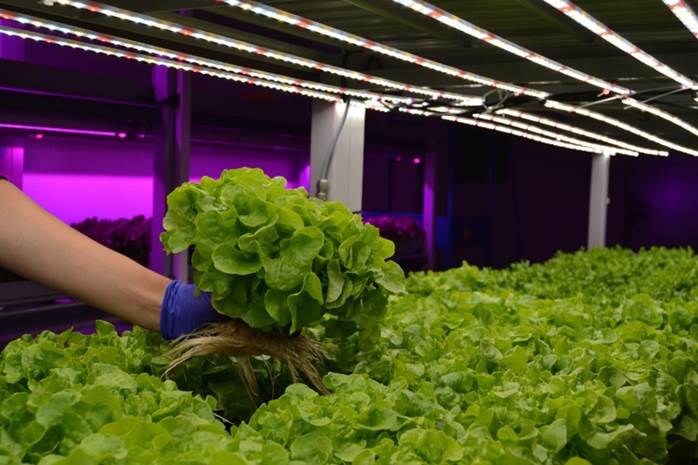
In recent years, the vertical farm market has gone through a turbulent period. On the one hand, we have seen spectacular collapses and bankruptcies of companies in the U.S. and the EU, and on the other, record investments for top players. This is a natural stage in the evolution of the industry, which today is learning lessons and entering a phase of mature growth.
From euphoria to selection
According to a report by AgFunder, investment in the Controlled Environment Agriculture (CEA) sector, which includes vertical farms, fell 53% in 2024. The reasons were high energy costs, difficulties with scaling and flawed business models.
This was a necessary market correction. Companies that control costs, implement automation with benefit analysis and align their businesses with real demand continue to grow. The market has rejected visions detached from reality: efficiency, scalability and discipline are what counts.
A smart approach is one that designs technology with reasonable CAPEX, automates where it really makes sense, and sticks to hard economic indicators. A vertical farm doesn’t have to be saturated with robots – it has to be cost-effective, risk-tolerant and recurring.
New wave of investment
Despite the decline in overall investment, many companies are still attracting significant financing:
Why do vertical farms make sense?
In Poland, which is an agricultural country, 68% of the salads and herbs consumed are imported, the value of which is about €200 million a year. Retail chains see this as a problem:
Farmers, producers and food industry stakeholders, as well as retail chains, make money when consumers buy the products they supply. That’s why they are looking for partners who will solve their problems. Hydropolis vertical farms provide that answer.
The consumer expects not only better quality, but also competitive prices. Vertical farms, which understand this better than others, are able to combine quality and price – eliminating the cost of transporting imported plants and minimizing environmental impact.
This is a future that cannot be ignored.
How does Hydropolis succeed where others have failed?
Farms are supposed to make money. The focus is on:
I had the opportunity to see a vertical farm recently, in Taiwan, that is thriving. It is growing, even though it takes as long as 22 days to grow basil in its main system. We grow in 12 days, which means a higher annual yield, more revenue and less resource consumption.
Obtaining such advantages did not come easily. They required R&D work, knowledge, determination, discipline and the trust of Investors. A major developmental step for Hydropolis was the construction and launch of the first commercial farm. This allowed us to show that not only on the scale of an R&D center, but with a demonstration of full operating costs, packaging, logistics, the economics and business are sound. Show, Don’t Tell!
Hydropolis
Electricity, the main component of operating costs.
Nearly half of the cost of obtaining the product depends on this resource. In the farm we recently built, the price of electricity was contracted for three years ahead, at a fixed price of 505 PLN per MWh. In addition, thanks to the technological solutions we developed, energy consumption is more than 20% lower per plant than in competing systems.
Why invest in Hydropolis?
Because unlike companies that built “demonstration” vertical farms, we focus on:
We see that the vertical farm market is maturing and entering a phase of consolidation. Companies that had unrealistic assumptions or deficiencies on the R&D side have already collapsed. What’s left are those who can really deliver value – and at Hydropolis that’s exactly what we’re after.
We invite you to do business with us
At Hydropolis, we provide and develop technology. We believe that the agricultural market needs a quality change and we know that we can deliver it.If you want to be a part of this change – as an investor, a technology partner or an ambassador for a new model of agriculture – let’s talk!


